

Living in a society dominated by visual and written information, the ability to read without sight is genuinely revolutionary. By transforming words into touch, braille translations are life-changing for countless people around the globe.
Braille provides independence, enhances literacy, and ensures that information is accessible to all, promoting inclusivity and equal opportunities. Translating braille is not confined to books; it spans many materials, from public signage to product labels, educational resources, and more.
Whether you’re new to this subject or seeking to deepen your understanding, this article explores the fascinating world of braille translation.
A Brief History of Braille
Louis Braille invented Braille in the 19th century. Born in France, Louis lost his vision in childhood due to an accident.
His invention allowed people who were blind or had low vision to read and write independently. Over time, Braille transcended borders and became a universal system used across languages and regions, symbolizing liberation and equal opportunity.

Braille opens doors to education, employment, and personal growth for millions of people worldwide. Braille literacy provides independence, confidence, and a sense of belonging. Imagine navigating a world where written information is at your fingertips, literally. That is the power of Braille.
Understanding the Braille Alphabet

Understanding the Tactile Writing System of Braille
Braille is a complex, multi-faceted system that allows for encoding various information types. Each character, also known as a cell, consists of six dots arranged in a rectangle containing two columns of three dots each. Different combinations of these raised dots represent various letters, numbers, and punctuation marks.
Braille Was Built For Efficiency
The Braille alphabet includes lowercase and uppercase letters, achieved using a shift-like key. Beyond basic text, Braille also includes contractions and shorthand, allowing for more efficient reading and writing. For example, common words like “and,” “for,” and “the” have single-character representations.
Braille Includes Scientific Notation
Developed by Abraham Nemeth, Nemeth braille is used for mathematical and scientific notation. It ensures that subjects like mathematics, chemistry, and physics are accessible to visually impaired students, enabling them to pursue STEM fields without barriers.
Translating Text to Braille
Translating text into Braille is both an art and a science. The process involves several steps to ensure accuracy and readability.
Step 1: Digitizing the Text
The process begins with digitizing the text. That can be done by scanning the document using optical character recognition software, which converts the scanned images into editable digital text. Alternatively, this step can be bypassed if the text is already in a digital format.

Step 2: Verification and Proofreading
The Braille text then undergoes a thorough verification and proofreading process. This step involves multiple checks to identify any errors or inconsistencies. Experts read through the Braille to verify that all translations are correct and that the text flows naturally. That ensures that readers experience a seamless transition from printed text to Braille.

Step 3: Embossing and Displaying the Braille Text
Once the translation is verified, the text can be transformed into a physical or digital Braille format.

Admittedly, the three steps above oversimplify translating Braille into languages other than English. If you’d like to dive deeper into the whole process, we’ve provided a more thorough yet digestible overview here:
1. Braille Code
Each language has its specific Braille code that assigns combinations of characters to dots.
2. Source Text
The first step in translating Braille into another language is obtaining the source text that needs to be translated. This could be a document, book, menu, or any other material that requires translation into Braille.
3. Language Expertise
Translating Braille requires expertise in both the original language and the target language. Translators need to be fluent in both languages to ensure accurate text conversion while adhering to the rules of the Braille code for each language.
4. Transcription
The source text is transcribed into Braille using the specific Braille code for the target language. This involves converting each character, word, or symbol into the corresponding Braille representation.
5. Proofreading
Once the transcription is complete, the Braille text undergoes thorough proofreading to check for accuracy, consistency, and readability. Proofreaders ensure that the translation is faithful to the original text and that it follows the conventions of Braille in the target language.
7. Production
The final step involves producing the Braille document using a Braille embosser or printer. The raised dots are embossed onto paper to create tactile Braille text that individuals with visual impairments can read.
8. Quality Check
Before the translated Braille document is distributed, a final quality check is conducted to verify the accuracy of the translation, the clarity of the Braille representation, and the overall quality of the final output.
There are two main methods for presenting Braille:
- Embossing onto Braille Paper: A Braille printer (an embosser) creates raised dots on thick paper, allowing blind or visually impaired individuals to read by touch.
- Displaying on a Refreshable Braille Display: Refreshable Braille displays are used for digital texts. These devices contain small pins that move up and down to form Braille characters, enabling readers to access digital content in real-time.
Chain Restaurants Offering Braille and Large Print Menus
Many chain restaurants have taken proactive steps to accommodate the needs of vision-impaired individuals by providing Braille menus.
This thoughtful initiative reflects a commitment to creating a welcoming environment where guests feel valued and accommodated.
By offering Braille menus, chain restaurants demonstrate a dedication to accessibility that goes beyond mere compliance with regulations. These menus empower vision-impaired customers to independently peruse the menu offerings, make informed choices, and fully participate in the dining experience.
It’s all about inclusivity.

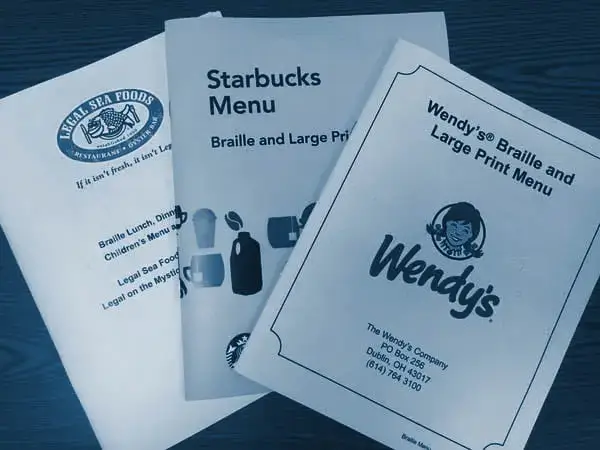
Large print menus further underscore chain restaurants’ commitment to inclusivity. They cater to individuals with varying degrees of visual impairment, including those who may not read Braille but benefit from clearer, magnified text.
By offering menus in large print, restaurants extend their hospitality to a broader range of customers, ensuring that everyone can comfortably engage with the menu options and enjoy their dining experience.
The Numbers Speak Volumes
According to the World Health Organization, approximately 2.2 billion people worldwide have vision impairments or blindness.
Providing Braille and large print is crucial for ensuring inclusivity worldwide.
The Importance of Braille in the Digital Age
In an era dominated by screens and digital content, you might wonder about the relevance of Braille.
Know this: Braille remains an indispensable tool for those with visual impairments. While screen readers and audiobooks offer alternatives, Braille provides a unique tactile reading experience that enhances comprehension and retention.
Braille literacy is crucial for academic and professional success. Studies show that Braille learners are more likely to secure employment and achieve higher education. Braille allows for precise note-taking, proofreading, and learning, skills essential for any professional setting.
Braille builds independence and confidence. Imagine the freedom of navigating public spaces, reading menus, or signing legal documents with little to no assistance. Braille empowers the visually impaired to engage with the world around them, making it as relevant today as it was in the past.

We Stand Ready
Transatlantic Translations Group stands at the forefront of Braille translation services, embodying an unwavering commitment to accessibility and inclusivity.
Our dedication to precision and excellence ensures that every detail is meticulously translated, facilitating seamless communication for visually impaired individuals worldwide.
Combining cutting-edge technology with our team’s unparalleled expertise bridges the gap between digital text and tactile literacy, empowering all users to access essential information confidently.
Trust Transatlantic Translations Group to deliver not just translations but transformative solutions that elevate the standards of accessibility and communication in today’s interconnected world.