How do safety teams deliver OSHA training to a multilingual workforce?

Transatlantic Translations Group Articles / OSHA Training to a Multilingual Workforce

TTG Case Studies Logo

Last Update:

October 26, 2026

Prepared by:

Transatlantic Translations Group, Workplace Safety Language Services

In This Article

Primary Sources

Safety Training Language Review

We help safety teams match training to the languages their crews work in.
Quick Answer: OSHA does not require safety training to be delivered in English, nor does it require a translated copy of every document. It requires that training be presented in a language and vocabulary the workers receiving it can understand.
The most practical way to meet that standard is to follow the language the work already runs in. If a crew receives its daily instructions in Spanish or Vietnamese, its safety training is conducted in the same language, and comprehension is checked in that language as well. Labels and safety data sheets remain in English, with other languages added where they are helpful.

What does OSHA actually require for workers who speak other languages?

Most OSHA standards that call for training use plain verbs such as "train" and "instruct". OSHA's Training Standards Policy Statement clarifies what those verbs mean: presenting information in a manner that the people receiving it can understand. The position covers agriculture, construction, general industry, and maritime, and addresses vocabulary, literacy, and language. A worker who cannot read is not trained by being handed a binder.
The most useful sentence in that statement is also the simplest. If an employer customarily gives work instructions in a language other than English, it is expected to deliver safety and health training the same way. We think this is the right starting point for any safety team, because it turns an abstract standard into a question every site manager can already answer: what language does the work run in?

Does every document need to be translated?

No, and treating the requirement as a translation mandate usually wastes budget. Under the Hazard Communication Standard, workplace labels and safety data sheets remain in English. Employers may add other languages to labels, and may keep safety data sheets in other languages alongside the English originals. In construction, OSHA has also said that the duty to communicate on site can be met by any system in which communication reliably occurs, with no requirement that the system be English-based.
What needs to reach workers in their own language is the training itself: the live session, the demonstration, the questions and answers. Supporting documents follow from there, prioritized by what workers actually consult on the job. Procedure cards at a machine, supplemental label text in a chemical storage area, and job hazard analyses reviewed at the start of a shift tend to come first. A policy manual that no one on the floor opens can usually wait.

How do teams show that training was understood?

Several OSHA standards already build comprehension into the training itself. Lockout/tagout requires the employer to verify that employees acquired the knowledge and skills they were trained on. Respiratory protection requires retraining when an employee has not retained the necessary understanding. Bloodborne pathogens training requires an opportunity for interactive questions with the person running the session.
Each of these checks only works in the language the worker thinks in. A question-and-answer period held in English for a crew that works in Spanish meets the schedule but misses the point.
Teams that handle this well ask workers to explain a procedure back in their own words, have them demonstrate it, and note the training language on the sign-in record so the file shows how comprehension was established.
OSHA standards that build in comprehension checks: lockout/tagout requires verifying employees acquired the knowledge and skills, respiratory protection requires retraining when understanding is not retained, and bloodborne pathogens training requires interactive questions. Each check works only in the language the worker thinks in.

What role should bilingual supervisors play?

Most multilingual sites lean on a bilingual lead, and those people are genuinely valuable. The difficulty is that informal interpreting of technical content tends to drift over time. Terms get simplified, qualifications get dropped, and two supervisors on different shifts end up describing the same energy isolation step in different words.
A steadier arrangement divides the work by type. Fixed content, such as training modules, procedure cards, and supplemental label text, is translated professionally and reviewed once. Formal sessions, incident investigations, and anything with a comprehension check use qualified interpreters. Bilingual supervisors handle daily reinforcement, which is where they are strongest. A shared site glossary ties all three together, so that lockout, confined space, and permit terminology stays consistent whether it appears in a module, a toolbox talk, or an interpreter's rendering.

Why is the HazCom update a good moment to review training languages?

OSHA updated the Hazard Communication Standard in 2024 and adjusted the compliance dates in January 2026. For substances, employers are expected to update their hazard communication programs and provide any additional training on newly identified hazards by November 20, 2026. The corresponding date for mixtures is May 19, 2028.
Since HazCom training content is being revisited anyway as updated safety data sheets arrive, this is a natural point to confirm that the revised training reaches every crew member in the language they work in. Teams that build the glossary and translate the core modules now will find later updates much lighter, because each revision becomes a change to existing material rather than a new project.
Employers in state-plan states should also review their state's rules, since some state plans specify language requirements more directly than the federal standards.

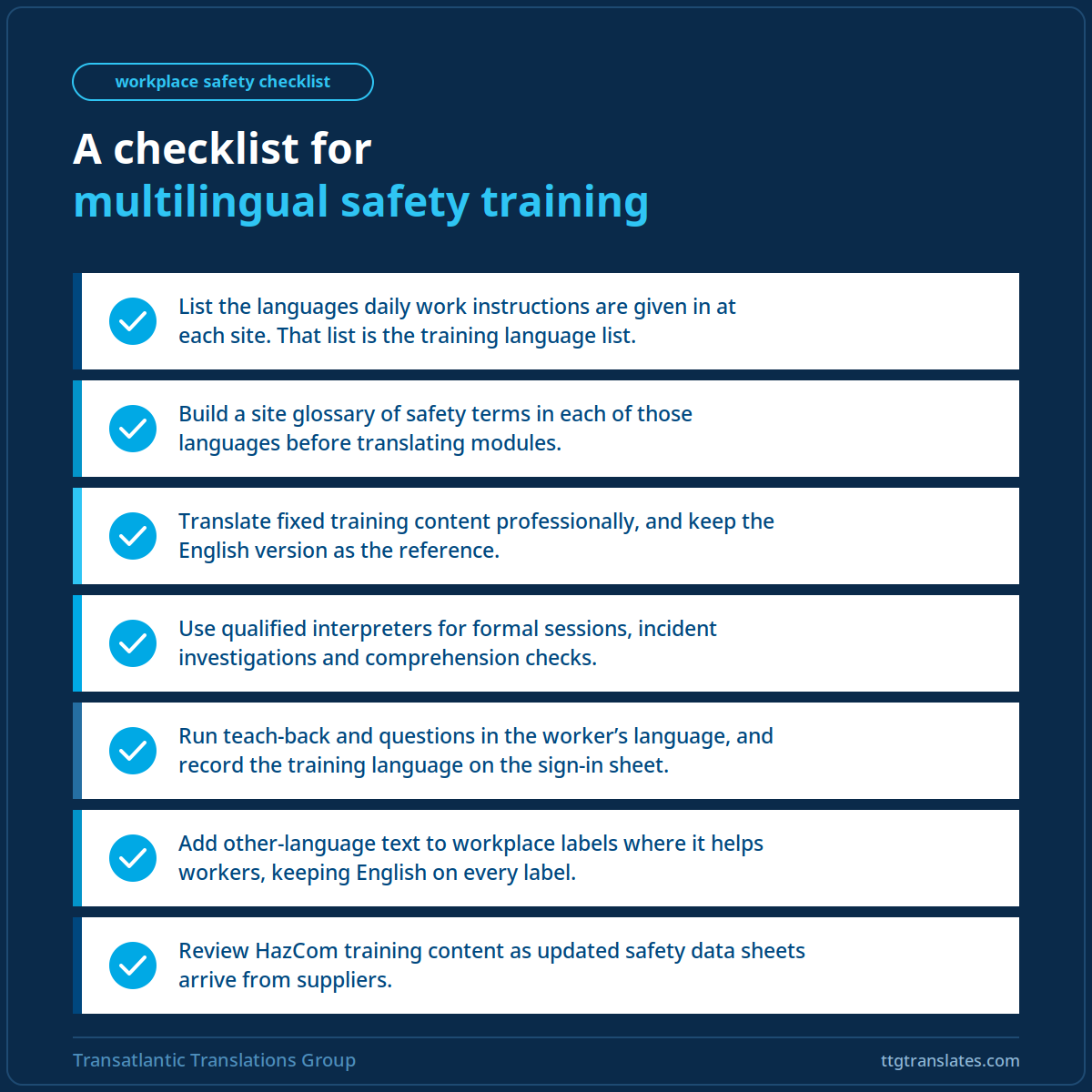
A checklist for multilingual safety training

  • List the languages used for daily work instructions at each site. That list is the training language list.
  • Build a site glossary of safety terms in each of those languages before translating modules.
  • Translate fixed training content professionally, and keep the English version as the reference.
  • Use qualified interpreters for formal sessions, incident investigations, and comprehension checks.
  • Run teach-back and questions in the worker's language, and record the training language on the sign-in sheet.
  • Add other-language text to workplace labels where it helps workers, keeping English on every label.
  • Review HazCom training content as updated safety data sheets arrive from suppliers.
A checklist for multilingual safety training: list the languages used for daily work instructions, build a site glossary, translate fixed training content professionally, use qualified interpreters for formal sessions and investigations, run teach-back in the worker's language, add other-language label text while keeping English, and review HazCom training as updated safety data sheets arrive.
At Transatlantic Translations Group, we translate safety training, procedures, and label content into more than 250 languages and provide interpreters for training sessions and investigations.

Ready to Elevate Your Language Services Strategy?

Contact Transatlantic Translations Group

TTG Case Studies Logo

Get expert answers and tailored linguistic guidance fast.

Complete this form to book a brief discovery call with a TTG specialist. We’ll contact you within one business day to discuss your enquiry.

This field is for validation purposes and should be left unchanged.


View Case Studies

Frontline Case Study Menu Image

Frontline

How a UK telephone answering service gained competitive advantage and new revenue streams with complete 21-language support.

Read Story →

Read time: 93 seconds

Willis Towers Watson Case Study Menu Image

Willis Towers Watson

How translation memory and vendor consolidation standardized global documentation across 40+ locations while reducing overall costs.

Read Story →

Read time: 89 seconds

Anonymous Restaurant Group Case Study Menu Image

Anonymous Company

How the company streamlined HR communications and employee relations across 2,300+ locations with smart telephone interpreting.

Read Story →

Read time: 86 seconds

Duncan Solutions Case Study Menu Image

Duncan Solutions

How compliant, culturally appropriate debt collection interpreting calls improved revenue recovery while preserving client relationships.

Read Story →

Read time: 106 seconds

South Shore Orthopedics Case Study Menu Image

South Shore Orthopedics

How remote telephone interpreting eliminated costly in-person interpreter fees while significantly improving patient privacy and comfort.

Read Story →

Read time: 103 seconds

Eakin Healthcare Case Study Menu Image

Eakin Healthcare Group

How a medical device manufacturer transformed translation from compliance cost to competitive advantage across 60+ markets.

Read Story →

Read time: 108 seconds

AnswerNet Case Study Menu Image

AnswerNet

How 39-language interpreting support across 31 North American sites became the primary competitive differentiator for key communications.

Read Story →

Read time: 94 seconds

Lippincottt Case Study Menu Image

Lippincott

How comprehensive linguistic and logo screening effectively protects global brand investments and prevents costly disasters.

Read Story →

Read time: 124 seconds

Anonymous Market Research Case Study Menu Image_v2

Anonymous Company

How precise survey translation and post-programming QA helped deliver culturally relevant research across diverse global markets.

Read Story →

Read time: 104 seconds

OnePoll Case Study Menu Image

OnePoll

How precise survey translation and complex piping handling enabled seamless international market research for media-ready insights.

Read Story →

Read time: 141 seconds

UCI Case Study Menu Image

UCI

How AI and human transcription deliver precision race commentary within 24 hours, enhancing fan experience across global cycling events.

Read Story →

Read time: 103 seconds

USP Marketing Consultancy Case Study Menu Image

USP MC

How survey translation and piping management enabled reliable international research in construction and home improvement.

Read Story →

Read time: 119 seconds

Anonymous Healthcare Proivider Case Study Menu Image

Anonymous Company

How enterprise language services ensured CMS-compliant member communications and full accessibility support for 4.7M healthcare members.

Read Story →

Read time: 128 seconds